
Weston & Sampson
Henson Creek Hydraulic Model - Climate Resilient Flood Risk Management
Project Overview
The Henson Creek Hydraulic Model project was designed to simulate flood behavior and hydraulic characteristics of Henson Creek and its six tributaries, incorporating climate resilience and nature-based solutions (NBS) to strengthen water management and infrastructure sustainability.
The model extended the existing HEC-RAS framework, which originally covered 39,252 feet of Henson Creek, by adding 69,830 feet upstream to the I-95 Capital Beltway and four additional tributaries. This expansion provided a comprehensive understanding of hydrological dynamics, enabling improved flood risk management and climate-adaptive infrastructure planning.
Study Components
Integrated Hydraulic Model Development
- Extended the HEC-RAS model to cover 69,830 feet upstream and four tributaries.
- Simulated flood events and water surface profiles to assess flood-prone areas.
- Integrated climate resilience strategies and NBS (wetlands, floodplain buffers) into model design.
Cross-Section and Geometry Setup
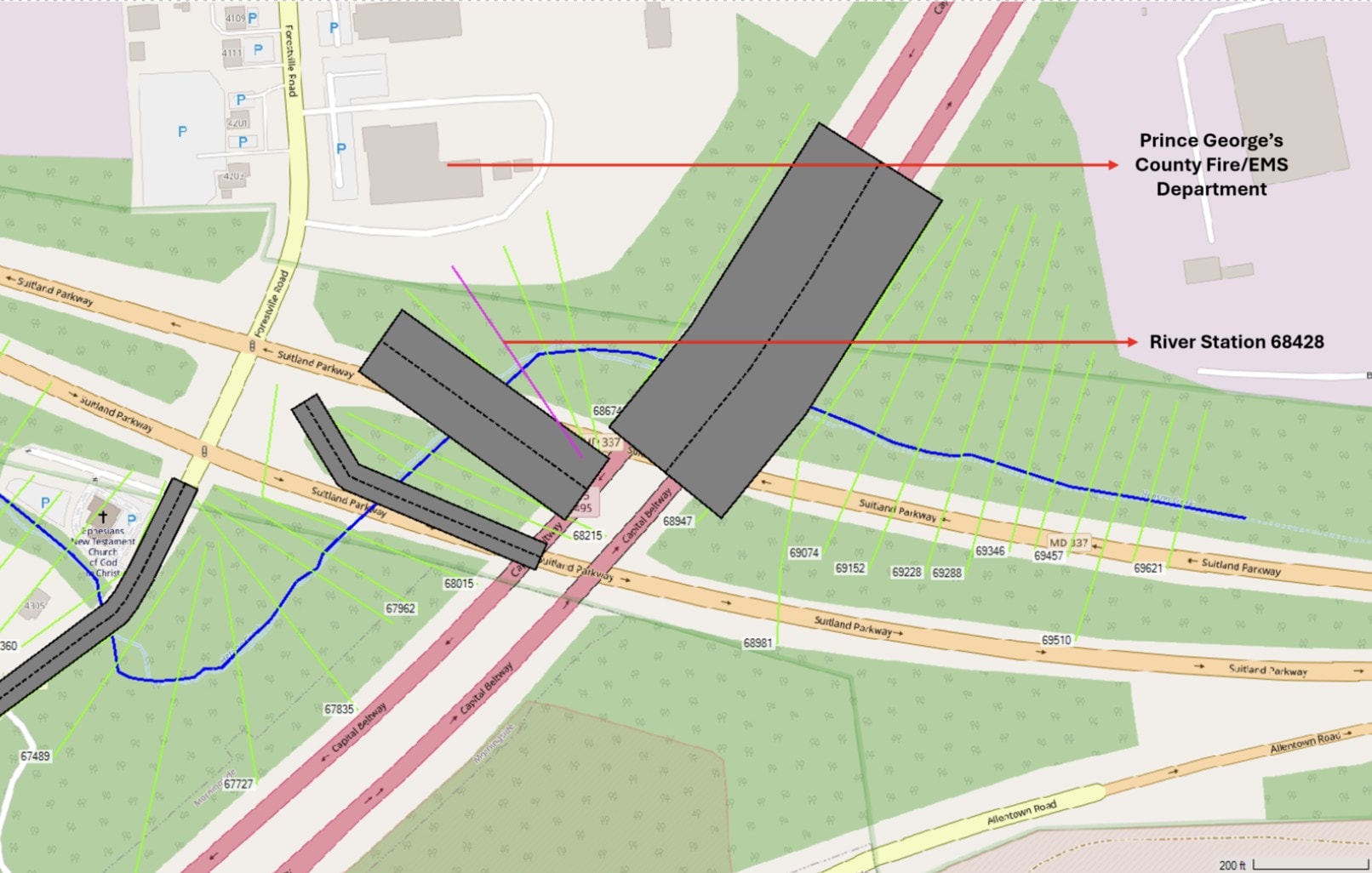
- Placed cross-sections every 200 feet using 3-meter DEM and RAS Mapper.
- Aligned cross-sections with natural land features; named sections by distance from creek mouth.
River Bank Station Placement and Adjustments
- Positioned bank stations using steady-state simulations for 2- and 500-year return periods.
- Adjusted stations to improve accuracy in flood modeling and erosion risk management.
Modeling of Culverts, Bridges, and Structures
- Incorporated 33 structures (culverts, bridges) into the model.
- Integrated elevation data from DEM, SWMM, and satellite imagery.
- Simulated structural resilience under extreme weather events.
Energy Losses and Flow Changes
- Adjusted model parameters to accurately estimate energy losses.
- Captured flow changes due to narrowing/widening of channels.
Structural Integration and Flood Resilience
- Modeled culverts, bridges, and embankments to assess impacts on flow dynamics.
- Incorporated NBS such as floodplain buffers and wetlands to enhance resilience.
Deliverables
- Extended HEC-RAS hydraulic model covering 69,830 feet upstream and six tributaries.
- Flood simulations for 2-year and 500-year return periods.
- Cross-section and geometry datasets aligned with DEM and natural features.
- Structural resilience modeling for 33 culverts and bridges.
- Climate-resilient recommendations integrating NBS into floodplain management.